
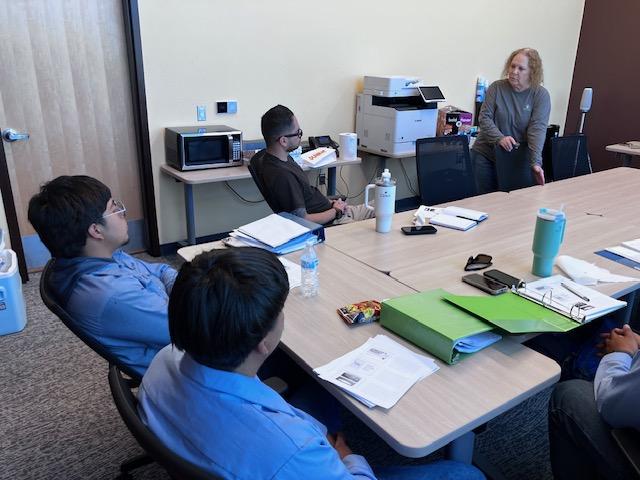
The Camino Real Regional Utility Authority (CRRUA) continues to invest in workforce development by offering in-house instructional classes designed to help water/wastewater operators prepare for New Mexico Environment Department (NMED) certification exams. CRRUA provides water and wastewater services in Sunland Park and Santa Teresa, NM.
Recognizing the growing need to develop a skilled local workforce in the highly competitive water and wastewater industry, CRRUA Executive Director Juan Crosby initiated the in-house instructional program in 2025.
“We saw a clear need to invest in our local workforce and create a pipeline of qualified operators right here in our community,” Crosby said. “This program gives team members the opportunity to earn while they learn, gain valuable hands-on experience, and build the credentials they need to succeed in a highly competitive field while serving their community.”
Since April 8, 2025, instructor Terry Mount has been leading bi-monthly training sessions for CRRUA staff. Mount is a former instructor and department chair with the Dona Ana Community College (DACC) where she oversaw the Water Technology Program, the Electrical Program, Automotive Technology, HVAC and Welding Technology. She has more than 30 years of experience in the water/wastewater industry.
In addition to her work with CRRUA, Mount also teaches for the New Mexico Water and Wastewater Association, including short schools and workshops that support operator development statewide.
Unlike traditional semester-based programs, the ongoing classes are structured to provide continuous learning opportunities. Each training day includes two hours on water systems and two hours on wastewater operations, allowing participants to build knowledge across both disciplines.
The primary goal of CRRUA’s program is to prepare utility operators for NMED certification exams and support them in advancing their careers. Entry-level employees can use the in-house instruction to work toward obtaining their Level I certification. While the program emphasizes Levels I and II, it also expands into advanced wastewater topics for Levels III and IV certifications.
Topics are aligned with certification exam content and include laboratory analysis, mathematical calculations, disinfection processes, wastewater operations, trickling filters, clarifiers, activated sludge systems, pH control, wells, backflow prevention, distribution systems, and government regulations.
To be eligible for certification testing, operators must meet two key requirements:
- A minimum of one year of on-the-job experience.
- Completion of required training credits.
A high school diploma or GED is also required for all certification levels.
Time spent in class counts toward training credits, with one hour of instruction equaling one training credit. Participants can earn a minimum of 24 training credits through the program. Operators must accumulate at least 30 training credits every three years to maintain certification, and all courses must be approved by NMED.
CRRUA’s approach is unique in its commitment to continuous, in-house training rather than relying solely on occasional specialized courses. Employees are compensated for their time attending classes, further reinforcing the organization’s dedication to professional development.
The success of the program is reflected in employee achievements, including operators who have successfully passed advanced certification levels after participating in the training.
By providing consistent, accessible education, CRRUA is strengthening its workforce and ensuring high-quality water and wastewater services for the community.
-0-